
Seeds for Growth
2016 CalABA Conference
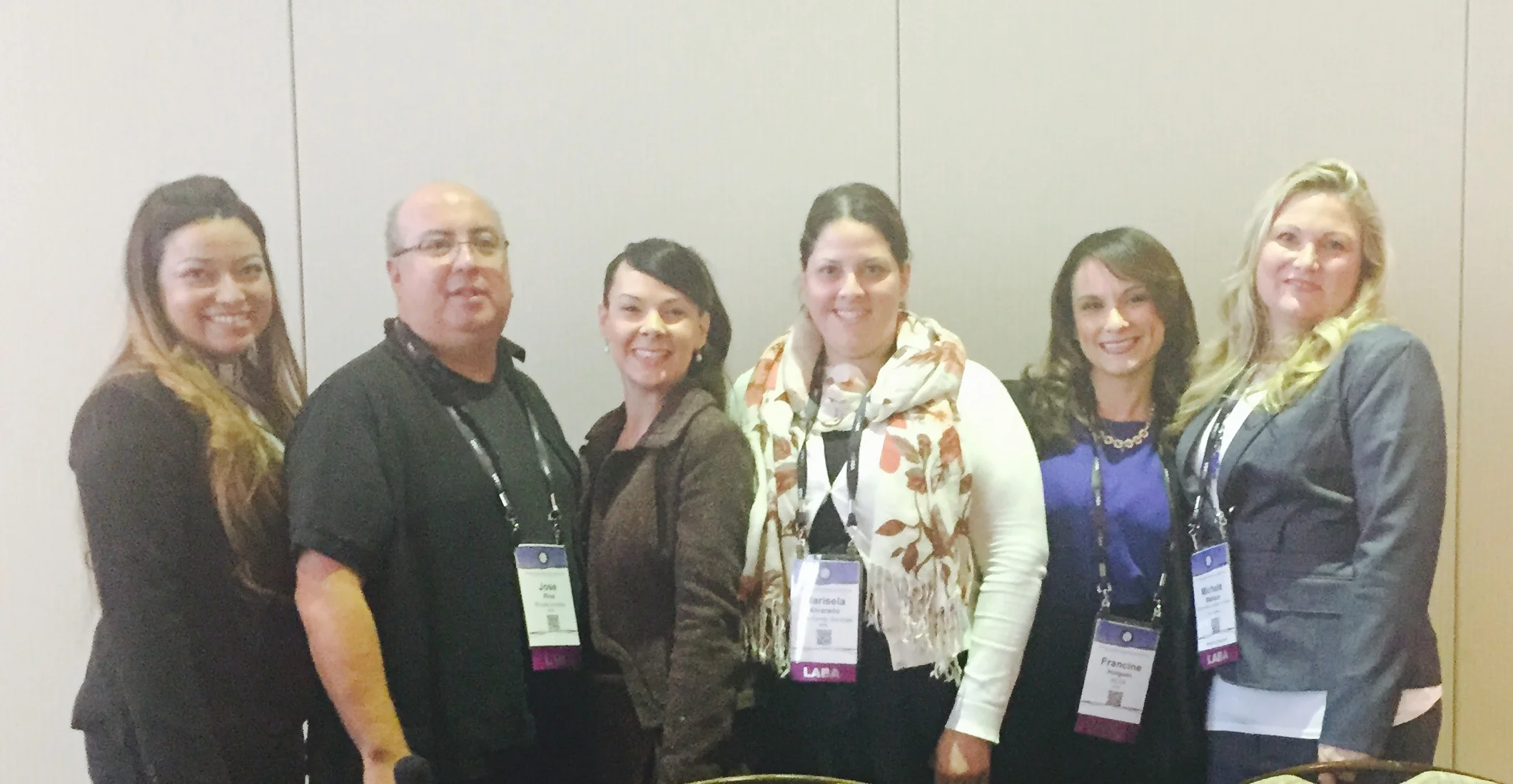
Presenters at the 2016 Calaba Conference, Symposium: Behavioral Parent Training and In-home Consultation: Looking back, looking forward
Denice Renteria-Gonzalez, Jose D. Rios, Kristine D. Dickson, Marisela Alvarado, Francine Holguin and Michele Wallace
We Don't Learn Our ABC's by Saying Them... We Sing!
Music is universal. Its origins are known in every culture, as there has yet to be discovered a culture that does not integrate music into their society (Worth, 1997). Music containing lyrics is a powerful form of expression that dates back to ancient Sanskrit Dramas of India and the Greek Dramas of Classical Antiquity. Music offers us as a species an entire new vocabulary for self-expression. As Plato declared, “Music is moral law. It gives the soul to the universe, wings to the mind, flight to the imagination, and charm and gaiety to life and to everything” (Paquette & Rieg, 2008).
Music is universal. Its origins are known in every culture, as there has yet to be discovered a culture that does not integrate music into their society (Worth, 1997). Music containing lyrics is a powerful form of expression that dates back to ancient Sanskrit Dramas of India and the Greek Dramas of Classical Antiquity. Music offers us as a species an entire new vocabulary for self-expression. As Plato declared, “Music is moral law. It gives the soul to the universe, wings to the mind, flight to the imagination, and charm and gaiety to life and to everything” (Paquette & Rieg, 2008).
In the field of psychology, music is known to evoke feelings, emotions, memories, and thoughts. Millions of studies have been conducted on the power of music, however in recent years the topic of music has emerged in experiments regarding language acquisition. “Comparing language and music is a tradition inherited from Aristotle and Darwin” (Williamson, 2009). However, psychologists are just presently beginning to understand why music affects the way we learn, how music is processed in the brain, and the similarities and differences between these two universal forms of communication (Williamson, 2009). Such similarities between music and language are that they both involve the perception of sound, highly structured systems with syntax, discrete and measurable elements, belong to a hierarchically organization of sequences, acquire implicit knowledge and are interpreted through the lens of perception (Jentschke, Koelsch, Sallat, and Friederici, 2008).
Overlap in Neural Structural Processing
A recent experiment, conducted by Fedorenko, Patel, Casasanto, Winawer, Gibson, found evidence to support the idea that language and music share an overlap in online processing and some aspects of structural integration; in addition, to successfully being the first to demonstrate an “interaction between linguistic and musical structural complexity for well-formed (grammatical) sentences” (2009). This experiment gives credibility to Patel’s Shared Syntactic Integration Resource Hypothesis, which states that although the linguistic and musical knowledge systems may be independent; the system for online structural integration may be shared between music and language (Fedorenko, Patel, Casasanto, Winawer, & Gibson, 2009).
Neuropsychological experiments have utilized magneto-encephalography, event-related potentials and functional magnetic resonance imaging to support the idea that structural manipulations in music activate the Broca Area’s surrounding cortical regions (Stromswold, Caplan, Alpert & Rauch, 1996), which have a proven history in relation to the structural processing of speech and language (Patel, Gibson, Ratner, Besson & Holocomb, 1998; Besson & Faita, 1995; Janata, 1995; Fedorenko, Patel, Casasanto, Winawer, & Gibson, 2009). In addition, experiments have been conducted to further develop the localization of music and speech to the right-hemisphere homologue (Koelsch, 2000; Koelsch, 2002; Levitin & Menon, 2003).
Music Therapy and Joint Collaboration Treatments
Musical therapy has been included in multiple treatment modules and has found to be beneficial in collaboration with speech-language pathologist’s treatment modules for language acquisition (Hobson, 2006). To further this point, in 2000 Pellitteri claimed that children in a musical environment felt at ease, allowing natural language to emerge (McCarthy, Geist, Zojwala & Schock, 2008). Although there is a lack of knowledge regarding the profession surrounding music therapy and their work with speech pathologist; McCarthy, Geist, Zojwala and Schock conducted an internet-based survey with 1675 Board Certified Music Therapists and their work with speech-language pathologists to better explore music’s affect on language, academics, gross/fine motor and behavioral interventions (2008).
The survey projected that 3 out of 4 musical therapists will work with speech-language pathologists in joint collaboration, and that the list of benefits included client’s progress in the areas of expressive communication (rating 5.86 out of 7), receptive communication (rating 5.19 out of 7), fine/gross motor (rating 4.62 out of 7), socialization (rating 5.15 out of 7), emotional/behavioral (rating 4.76 out of 7), and academic (rating 4.24 out of 7) (McCarthy, Geist, Zojwala & Schock, 2008).
I found these results interesting because my work as a behavior analyst not only includes music, but centers around the writing of treatment plans for the exact same skill areas to which this study found a reported benefit. In addition, I too hold joint collaborative session with a music therapist and have found it to be beneficial to my clients. One substantial difference between the treatments modules is that a behavior analysts breaks down the skill subgroups into components, operationally defined responses and systematically reinforces skills while collecting daily data on every attempt made by the child. Pivotal Response Training, within the science of applied behavior analysis, relies can involve music as a component for the treatment of language delay, specifically for children diagnosed with Autism Spectrum Disorders.
Promoting Language in Children with Communication Impairments
Other studies have focused on utilizing music therapy in a co-treatment modules for children with severe language delay; such as Bruchia’s 1982 research experiment in which he treated a 14 year old male with mental retardation for language impairment of echolia in a successful single-subject research design which decreased 95% of the total echolia utterances to the level of 10% (Geist, McCarthy, Rodgers-Smith and Jessica Porter, 2008).
Another preliminary successful single-subject experiment was completed using a classroom-based collaborative speech-language pathology/music therapy module in which a 4-year-old child diagnosed with bronchopulmonary dysphasia increased skills in language comprehension, language expression and gesturing, in addition to social interaction, increased levels of engagement, play skills and use of his voice output device (Geist, McCarthy, Rodgers-Smith and Jessica Porter, 2008).
Conclusion
A precise and detailed relationship between music and language acquisition is yet to be declared in the empirical scientific realm. However, very interesting studies are being conducted in terms of how music could possible influence or enhance language acquisition. This research question is socially valid, as it would truly enhance the current treatment modules for teaching language and treating language delay. Regarding perception, language is vital to the way that we communicate and understand the world. As language is a contrived construct, it needs to be taught. As perception is an active process of the individual, one can truly come to appreciate the role of speech and language in how it shapes our perception. Without the understanding of language and our ability to communicate with others, we would be isolated in our perception. Without music, life would just be dull. Music is more powerful than we currently understand it to be. As
Aristotle wrote, "Music has a power of forming the character, and should therefore be introduced into the education of the young."
Bibliography
Aristotle. (1447ad.). Great-Quotes.com. Retrieved December 14, 2011, from Great-Quotes.com Web site
Fedorenko, E., Patel, A., Casasanto, D., Winawer, J., & Gibson, E. (2009). Structural integration in language and music: Evidence for a shared system. Memory & Cognition. 37(1), 1-9.
Geist, K., McCarthy, J., Rodgers-Smith, A., & Porter, J. (2008). Integrating music therapy services and speech-language therapy services for children with severe communication impairments: A co-treatment model. Journal of Instructional Psychology. 35(4), 311-316.
Jentschke, S., Koelsch, S., Sallat, S., & Friederici, A. D. (2008). Children with specific language impairment also show impairment of music-syntactic processing. Journal of Cognitive Neuroscience. 20(11), 1940-1951.
Lim, H. A. (2009). Use of music to improve speech production in children with autism spectrum disorders. Theoretical orientation. Music Therapy Perspectives. 27(2), 103-114. Retrieved from EBSCO host.
Patel, A. D. (2008). Music, language, and the brain. New York, NY US: Oxford University Press. Retrieved from EBSCO host.
Schön, D., Boyer, M., Moreno, S., Besson, M., Peretz, I., & Kolinsky, R. (2008). Songs as an aid for language acquisition. Cognition. 106(2), 975-983.
Weiss, M. (2009). Increasing receptive, expressive, and overall language skills in language-delayed preschool students. Dissertation Abstracts International Section A, 70, Retrieved from EBSCO host
Williamson, V. (2009). Special issue: The power of music. The Psychologist. 22(12), 1022-1025.
Worth, S. (1997). Wittgenstein's Musical Understanding" British Journal of Aesthetics. (37), 158-167.
Ms. Kristine D. Dickson, BCBA
Owner/Clinical Director
Nurture & Nature Applied Behavior Analysis and Consultation
5318 Laurel Canyon Blvd., Suite 101,
Valley Village, CA 91607
(818) 613-1206

Keeping it Real - Friendly Vocabulary of ABA
Applied Behavior Analysis (ABA) - Applied Behavior Analysis is a science that studies socially important behaviors.
- Applied Behavior Analysis (ABA) - Applied Behavior Analysis is a science that studies socially important behaviors. A behavior is anything a person can say or do. Behaviors must be observable and recordable. Through ABA, problematic behaviors (i.e., behaviors that negatively affect the lives of the individual or those around him) are measured and changed through assessments and behavior change programs. The application of ABA examines the antecedents (i.e., where, when, and with whom the behavior occurs), the behavior (i.e., what the behavior looks like), and consequences (i.e., what the person gets out of the behavior, what the person avoids because of the behavior, how others react because of the behavior, etc). ABA examines these factors and creates behavior change programs to lessen problematic behaviors and increase socially appropriate behaviors. An example of this is when a family needs help with their son, Timmy, who tantrums (problematic behavior) to get toys. An intervention plan could be created to teach the son to ask for toys (appropriate behavior) instead. Both behaviors would be observed over time and data would be taken to evaluate the effects of the behavior plan.
- Differential Reinforcement - Reinforcement is similar to what individuals outside of the field call “rewards”. Differential reinforcement is used to teach individuals socially appropriate behaviors by rewarding individuals for engaging in appropriate behavior (e.g., parents will reward Timmy for asking for his toys instead of tantruming). The second part of this involves the behaviors that are inappropriate are not being rewarded (e.g., parents will not allow Timmy to have the toy if he tantrums). Therefore, the rewarded appropriate behaviors are likely to continue, and the non-rewarded inappropriate behaviors are likely to cease.
- Independent Variable - is the plan that will help improve behavior and teach new behaviors/skills. This plan can include a specific time the plan is being carried out, or a certain location where the plan is taking place. The main idea is to show how a new behavior is being measured. The big picture of the “independent variable” is to show how a “plan” is either helpful or unhelpful for the child/client. For example, take a plan that was made for helping a child improve his language skills, by teaching him to say, “I need to go to the bathroom.” To measure and evaluate how the plan is working, you would count how many times he said, “I need to go to the bathroom.” during one week. The number of times he said, “I need to go to the bathroom” would be placed on a graph to show if there is a rise or a fall in the number of times he said, “I need to go to the bathroom.” Since the goal is to support the new behavior, the graph should show a rise in the number of times he said, “I need to go to the bathroom.”
- Direct Assessment – The first step to writing a behavior intervention plan that helps someone increase appropriate behavior and decrease problem behavior is to understand why that person is engaging in the problem behavior in the first place. One way to gather information about why a person engages in a problem behavior is to conduct a direct assessment. This is where a trained individual directly watches a person’s behavior over a period of time, and writes down what happens immediately before the person exhibits the problem behavior and what happens immediately after they exhibit the problem behavior. They also write down exactly what the problem behavior looks like, using descriptive words. They make sure to watch the person in the environment where they usually exhibit the problem behavior, such as at school or in the person’s home. For example, Sally has been yelling a lot at school. A trained individual will come in and sit in Sally’s classroom (hopefully where Sally can’t see them) and take notes on what happens right before and right after each time she yells, and might also take notes on what the yelling sounds/looks like. By studying these notes, therapists, teachers, and parents can begin to understand what might be causing and/or allowing the yelling to continue, and why she is yelling in the first place.
- Operant Behavior - is behavior that has been shaped by consequences. Meaning if a child wants to get a candy bar at the grocery store and the parent says no, if the child cries and in return you buy the child the candy bar; you are teaching the child to cry in order to get what the child wants. The crying would be an example of operant behavior. Chances are that the next time the child wants something at the store and the parent says no, the child will cry.
- Functionally Equivalent Replacement Behavior (FERB) - is an appropriate behavior that fulfills the same need as the problematic behavior. Through teaching and reinforcing the child when he uses the functionally equivalent replacement behavior, the problematic behavior will decrease because the child will no longer have a need to use it. Eventually, the goal is for the functionally equivalent replacement behavior to completely take the place of the problematic behavior. An example of this would be if Jenny cries in school to get her teacher’s attention, Jenny would be taught the functionally equivalent replacement behavior of raising her hand in order to get her teacher’s attention. Both behaviors serve the same function of getting the teacher’s attention, and this is a crucial part of coming up with the functionally equivalent replacement behavior.
- Variability - is used when reading and understanding behavior data when graphed from an intervention plan. Variability describes behavior data, which can be very different across time, location or individual. This is usually seen by very high levels of the behavior mixed with very low levels of the behaviors (e.g., Katie sometimes asks for toys a lot in one day, but the next day only scratches to get toys). In this case, it is likely that the individual has not responded consistently to the intervention and therefore we have variability. For a behavior plan to change a problematic behavior, it is important for the data to be stable (i.e., relatively the same) rather than show variability in the data. However, variability is very common when the behavior is first being learned.
- Proactive Strategies - this is setting your child up for success. We examine what triggers the problematic behavior and create strategies to eliminate these triggers. This is very helpful when the child is trying to acquire new skills, and we want to reinforce the child all the time. Obviously, we cannot reinforce the child when they engage in problematic behaviors; therefore we use proactive strategies to eliminate what triggers the child's problematic behavior. An example of this would be if the child was afraid of the dark, and therefore refused to stay in her bed. Giving the child a nightlight and leaving the hallway light on would be a proactive strategy to keep the child in bed.
- Ecological Manipulations - Ecological manipulations refer to the changes that are made in the individual’s environment. These changes will set the individual up for success by adding or removing things in the environment. Triggers that were known to cause the problematic behaviors in the past could be removed (e.g., such as loud noises). To help the individual show the appropriate behavior, things could be added to the environment (e.g., an individual that has trouble with transitioning can be given a timer to signal when disliked activities need to be done).
- Chaining - For behaviors that involve multiple steps, such as brushing teeth or getting dressed, chaining is helpful to teach each step of the behavior. We break the behavior into multiple steps as to establish mastery before moving on to the next step. As each step is taught and rewarded, the individual will remember the steps that come before or followed each step. This “chaining” of steps will help the individual learn the order of steps, which could help them complete the entire task.
Ms. Kristine D. Dickson

Social skills are built over time and often require finesse
Humans, by nature, are social creatures, and therefore social skills are important in leading a productive life in our culture. Preschool children need to learn the social skills of making eye contact, communication, awareness of others, turn taking, engagement, responding when spoken to, cooperative-sociodramatic skills and play skills (Dean, 2009).
Many social skills are derived and developed early on within the first few years of life. During a typical child’s first few years, they develop the ability to understand other people’s perspectives and an awareness that other people have minds that are able to think. This awareness is called Theory of Mind, and it leads to the development of self-conscious emotions, such as pride and embarrassment (Kalat & Shoita, pg. 260, 2003). Some children may have problems with social interactions such as social reciprocal smiling to parents and joint attention, which aids in building the reinforcement contingency needed to acquire and learn new social skills (Siegel, pg. 64, 2003).
Typical elementary school children build upon the aforementioned skills, but in addition learn empathy, communication, figurative language, response to social reward, social imitation, ability to work in groups, understanding non-verbal social cues, flexibility in social interactions, parallel and complex play skills, social language and behaviors, shared roles, control of emotional responses, pride in personal effort, and the ability to follow the rules (Dean, 2009).
Social skills are built over time and often require finesse. The social skills needed for functioning adults are numerous and include the ability to work in a group, take constructive criticism, understand and abide by ethical codes, listen, get along with other people, accept other people’s differences, and emotional intelligence, to name a few. Emotional intelligence is the ability to understand and infer emotions in others people, to show empathy and compassion towards others, and to use emotions effectively in reasoning and problem solving (Kalat & Shiota, p. 206, 2003). Even in ABA interventions, I do believe that emotional intelligence plays a crucial role in developing social skills. Many of these skills develop early in life and that is why early intervention should incorporate the teaching of social skills.
Many interventions have been shown to have reliable results in teaching social skills to children with autism. Play skills help to develop communication skills, imagination, memory skills, emotional regulation and social skills. (Siegel pg.119-120, 2003). Play skills can be taught by using role-plays, priming, video modeling, peer modeling, peer mentoring and task analysis. However, one crucial element in all of these interventions is that we break down the social skills to be taught into smaller components, and use directive language (Dean, 2009). Also, self- monitoring is effective with older children to develop social skills. (Koegel, L. K., Koegel, R. L., Hurley, C., & Frea, W. D., 1992).
Any social skills intervention must target a specific skill, be explicitly taught, use direct instruction, have clear goals with social validity, and be socially beneficial to the child (Dean, 2009). In the community, there are multiple opportunities to take advantage of known social skills interventions such as incidental teaching and pivotal response training. One intervention that I have implemented with clients is a peer mentoring program, in which peers are selected, trained, and reinforced to give direct instruction to the client during free play activities. This has been successful in teaching children appropriate game playing skills and peer interactions. Although social skills are difficult to generalize, fostering positive social interaction with typical peers has been identified as an important factor in achieving socially valid outcomes (McGee, Almeida, Sulzer-Azaroff, & Feldman, 1992).